Writing a Product Description? Start With What Customers Gain
Turn product features into a clear product description. Choose one reader, explain the benefit and give them a useful next step.

The empty page asks for a headline. You have a list of features, several possible audiences and no obvious first sentence.
Instead of trying to write the finished page from the top down, build the explanation underneath it. A product page becomes easier to draft when you know what you want the reader to understand.
Start with three things you know are true
Write down three concrete things your product includes or does. Leave the polished language for later.
A useful feature is specific enough to explain: an editable layout, a downloadable file or an individual feedback session. “A great experience” is too vague to give you much to work with.
For each feature, answer two questions:
- What could a customer do, gain or avoid because of this?
- Why would that matter in the situation they are facing?
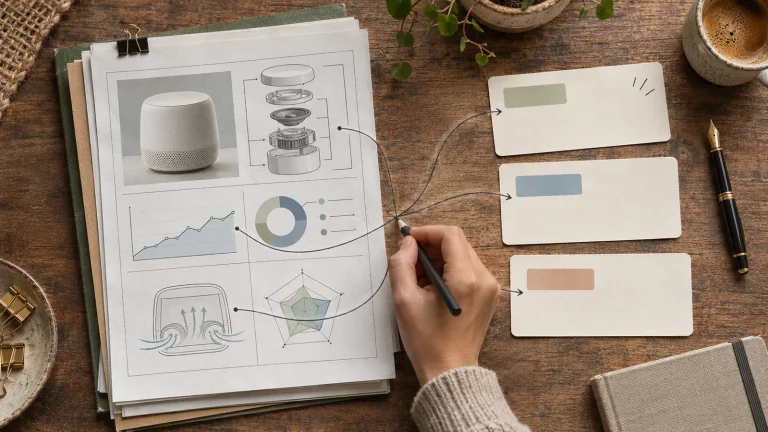
You now have a small feature–benefit–meaning map. It is raw material for your page, rather than a page you must publish exactly as written.
Choose one reader and one useful outcome
Your product may help different people for different reasons. An opening paragraph that tries to include every reason often says very little clearly.
Imagine one situation in which someone would consider your offer. What are they trying to accomplish? Where does the product make a practical difference?
Choose the connection that best answers those questions. Keep the others for supporting sections or other pages. If you are unsure who to lead with, compare the audiences who could benefit from your product. You are choosing the emphasis for this piece of writing, not declaring that the product has only one use.
Draft the middle before the headline
Here is an illustrative example for an imaginary editable presentation template:
Feature-led draft: “An editable presentation template with reusable layouts.”
Customer-focused draft: “Adapt a familiar layout for your next presentation, so you can spend your attention explaining the idea rather than rebuilding every slide.”
The second version connects the same feature with a practical use and a reason to care. It does not claim that everyone will finish twice as fast or win more business.
Try a similar paragraph for your own product. Explain the outcome, then show the real feature that makes it possible. If the sentence sounds unnatural when spoken aloud, simplify it.
Give the page a small, useful structure
You can build a first draft around five questions:
1. What is this for? Name the situation or task your reader recognizes. 2. What does it help me do? State the main customer benefit in ordinary language. 3. How does it do that? Connect the benefit with the relevant product features. 4. What do I need to know before starting? Answer a few genuine practical questions. 5. What should I do next? Give one clear action and a real destination.
Not every product needs a long page. Write enough for someone to understand the offer and decide whether to explore it. A section that repeats the same claim does not make the explanation stronger.
Write a headline that matches the page
Once the middle is clear, the headline has a job: help the right person recognize the subject and its value.
Use the language already emerging from your benefit map. Avoid forcing a dramatic promise onto a modest, useful product.
For an imaginary replayable workshop, “Revisit the difficult parts when you put the lesson into practice” says more than “The ultimate learning experience.” It also gives the page a concrete idea to explain.
The exact wording should fit what you sell and how your audience speaks. Treat a suggested headline as a draft to work with, not as an instruction to change the facts.
Check the route from interest to action
Read the page from the point of view of someone encountering the product for the first time.
Can they tell what they receive? Can they see a practical reason to want it? Does the button describe what happens next? Does its link go to the right page?
Keep price, availability and any conditions accurate. If you do not yet know a commercial detail, resolve it before making that detail part of your offer. Do not fill the gap with a persuasive invention.
Keep your starting material
Save the feature–benefit–meaning map alongside the draft. You can reuse a connection in an introduction, an answer to a customer question or a future article without starting the thinking again.
Benefit Generator is a free English mini-course that starts with 3–7 product or service features and produces a reusable table and text version. You can use that text as a starting point, then adapt it to the people and page you are writing for.
Explore the free Benefit Generator mini-course. Bring a few real features and start with one useful connection. You can improve a first draft; you cannot edit a blank page.


Keskustelu 1