
Which Design Decisions Should Your Client Make?
A client can choose the business priority without having to invent the layout. Make the division of judgement visible before asking for approval.
You show two versions of a page and ask which the client prefers. They choose the one that removes an important service condition. You now need a conversation about the decision itself, rather than a debate over who is allowed to like which layout.
Separate the kinds of judgement
Consider a fictional designer preparing a service page for a specialist furniture restorer. The owner wants a warm, traditional brand impression. The page must also help a visitor distinguish an assessment from an agreed restoration job. The current implementation has limits the designer needs to investigate before recommending a treatment.
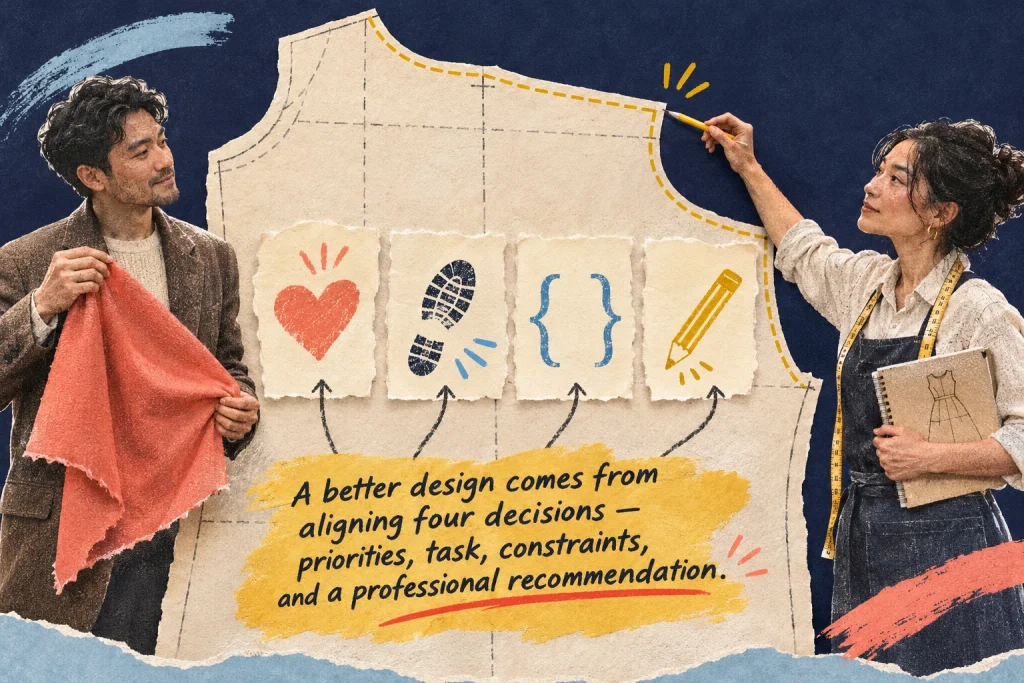
These are related questions, but asking the client to “approve the design” collapses them. Separate four contributions: the business or brand priority, the reader’s task, the implementation constraint and your professional recommendation. This framework defines the collaboration around a choice. It does not decide which stakeholder wins a dispute inside the client’s organisation.
Let the client establish the business priority
Ask what the business wants to communicate and which practical commitments the page must represent. The owner can confirm that an assessment does not promise acceptance of the restoration work. They can explain which parts of the brand matter and why a proposed treatment feels inconsistent with it.
Do not require them to express those priorities as a finished layout. “Keep the page calm and make the assessment boundary clear” gives you material for a recommendation. “Choose the button height” asks them to perform part of the design work without necessarily giving them the evidence or responsibility needed to do it well.
Make the reader task a shared reference
Write what the prospective customer should understand or do: recognise whether an assessment is appropriate, understand what it includes and know what information to send. Ask the client to check that this matches the actual service journey. If you have relevant user evidence, identify it; if this is a planning assumption, keep it labelled as such.
Use that task when discussing alternatives. The question becomes whether the proposed hierarchy keeps the assessment boundary understandable before the enquiry, rather than whether one person likes a more prominent action. A task statement guides the discussion; it does not prove how every visitor will behave.
Own the recommendation and disclose uncertainty
Your role is to explain the treatment you recommend and the reason it fits the agreed task and priorities. For example: “I recommend a short assessment summary beside the enquiry action, with the restoration decision explained separately. That keeps the service boundary close to the next step.”
If a technical question remains, identify who will investigate it and what it may change. Avoid presenting an unchecked constraint as an immovable fact, or promising a capability because it appears in the mock-up. Ask the client for the decision they can reasonably make while you take responsibility for establishing the implementation details needed for your advice.
Use a small decision card
For each substantial choice, record: business priority confirmed by the client; reader task; known constraint or open question; recommended treatment and reason; client judgement requested; next action. The requested judgement might be accepting the balance between brand expression and the amount of service detail, rather than selecting every visual property.
Read the card back before presenting alternatives. If the client wants to choose the treatment directly, clarify what they are choosing and which requirements remain. Respect their role without quietly describing the choice as your recommendation when it is not. Equally, do not treat your recommendation as permission to change the business offer.
Keep agreement attached to the choice
After the review, note the chosen direction and any unresolved condition. If a new concern appears later, return to the relevant question rather than insisting that an earlier preference settles everything. A useful collaboration lets the client contribute the knowledge and priorities they hold while expecting the designer to make, explain and revise a professional recommendation.
Agree which decisions need the client’s judgement and which need your professional recommendation. Keeping the reason beside the design makes a later discussion easier to continue.
For explaining the recommendation, use a comparison of design trade-offs around the same reader task. If the client’s stakeholders disagree about authority, use the separate framework for settling conflicting feedback.



Discussion 0
What did this article make you think about?