
A Voice Note Can Become Useful Website Feedback
A short audio extract and one confirmation question can preserve the business concern that a neat task title would otherwise erase.
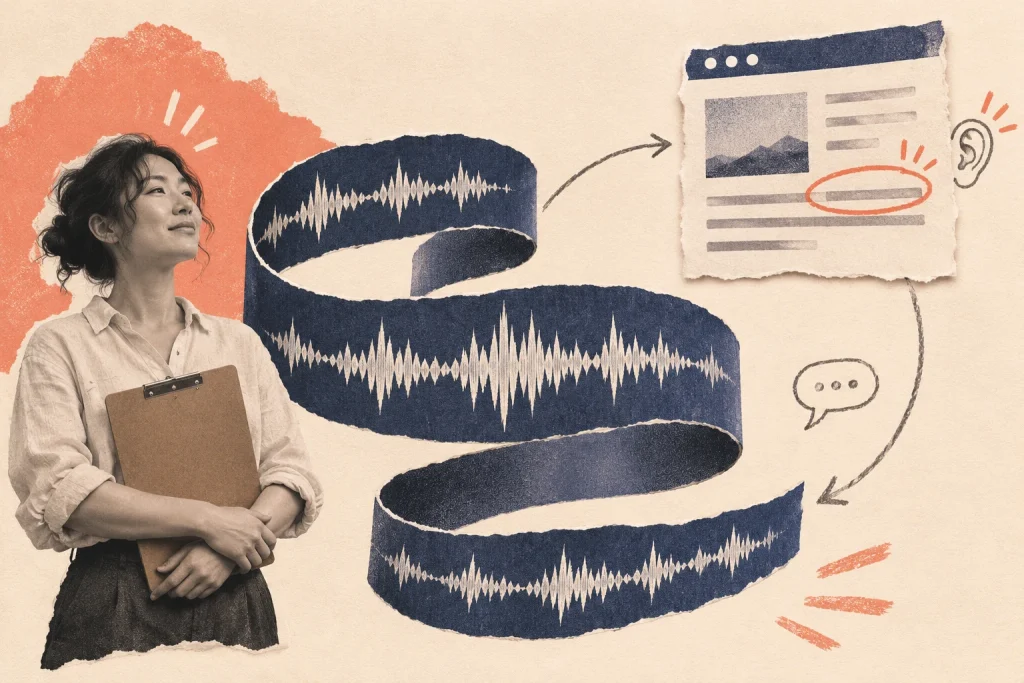
A client sends a ninety-second voice note while travelling between appointments. They mention the homepage, correct themselves, describe “the picture bit” and end with an important concern about what the service promises. Turning that into “change hero image” would lose most of the useful feedback.
Keep a small extract before writing the task
In this fictional example, a freelancer is reviewing a landscape designer’s service website. The client says: “The garden picture makes it sound as though you do the building too. I mean on the design page, below the first paragraph. We plan the work, but we don’t manage the contractors. Could that be clearer?” The immediate job is to preserve that distinction and establish its location, before choosing a design treatment.
You do not need to transcribe every pause. Keep the short passage that contains the observation, the relevant business fact and any uncertainty about the page. Label a paraphrase as a paraphrase. If the recording is difficult to understand, mark the uncertain word rather than confidently replacing it with a plausible service term. An automated transcript, if used, still needs checking against the recording and the client’s intended meaning.
Build a four-part transfer note
Use four headings: original words or faithful extract; page and element; meaning understood; question to confirm. Keep those parts separate so the client can correct your interpretation without having to rewrite your whole task record. Add the review version or date if the page may change before someone reads the note.
For the example, the note could read: “Extract: ‘We plan the work, but we don’t manage the contractors.’ Location: Design service page, image and caption below the opening paragraph; exact image to confirm. Understanding: the current combination may suggest construction management is included. Question: is the concern the photograph, the nearby wording, or their combined impression?” This is an illustrative note, not a finding about a real website.
Confirm the reference with a small choice
Send the relevant page address and describe the suspected element in ordinary language. A marked screenshot can supplement that description when appropriate, but do not make recognising your annotation the only way to answer. If there are two similar images, distinguish them by their surrounding headings or captions.
A useful reply is: “I understand that the page should make clear you provide design plans rather than manage contractors. Do you mean the photograph directly below ‘Your garden design’, or the project image further down? I have not selected a replacement yet.” This confirms both meaning and location while leaving the solution open. It also prevents the client mistaking your acknowledgement for an implemented change.
Transfer the confirmed meaning into the working item
After confirmation, write an actionable brief: “Clarify the boundary between design planning and contractor management beside the opening service description. Review the image, caption and wording together. Show the proposed treatment for a factual check.” Retain a short trace back to the relevant extract, within the project’s agreed handling of recordings and client material.
Do not copy the entire recording into every task. It may contain unrelated personal information or a separate business discussion. Carry forward what the work needs, and agree who handles the original message. If permission or handling arrangements are unclear, resolve those through the project’s established process rather than assuming a forwarded audio file belongs everywhere.
Read back the result in the client’s language
Close the transfer by summarising the issue the client raised and the next decision. “I have captured the service-boundary concern. I will show a revision of that section; you will check whether it accurately describes your role.” That is more informative than “audio added to board”.
The output is a confirmed observation with a stable page reference, not a polished transcript for its own sake. If the client later says your summary misses the point, return to the extract and amend the working interpretation. Preserve the correction instead of defending the first paraphrase.
Summarise the observation in the client’s own terms and confirm which part of the page it concerns. The important step is preserving the meaning when feedback moves into your working system.
Continue with The First Website Review Email Should Explain the Job and A Client Comment Is a Clue, Not Yet a Design Instruction.



Discussion 0
What did this article make you think about?