
The Launch Review Needs to Find Plausible Fiction Too
Obvious filler is easy to recognise. A plausible sample testimonial or service detail needs a source check, even when it fits the design beautifully.
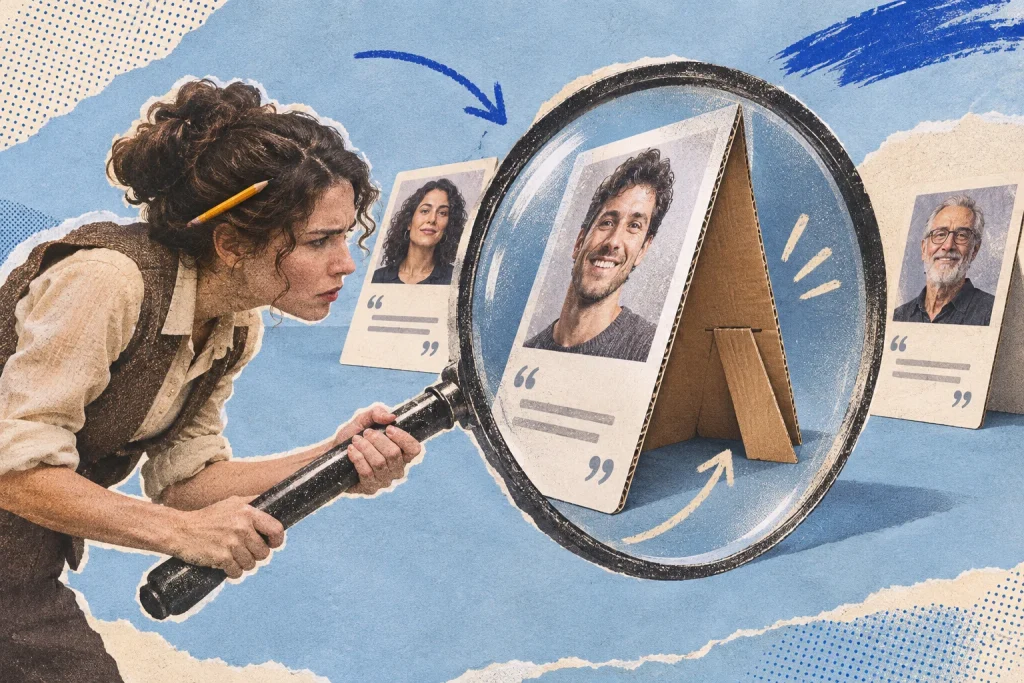
The placeholder search returns no results, and every page reads smoothly. A launch reviewer then asks where the customer quotation came from. It was written to fill a prototype card. Plausible fiction can survive the very polish that makes a draft feel ready.
Begin with the claims a visitor could believe
Imagine a fictional studio preparing a website for an outdoor-activity provider. During design, the team used invented guide names, example package descriptions and a sample customer quotation. Real photographs and final text have since replaced much of the material, but one attractive quotation card remains.
The review needs to ask more than whether temporary entries were removed. Read the page as a visitor: which names, statements, numbers or images appear to describe the actual business? A realistic-looking sample can sit inside an otherwise approved page. Its credibility is the reason it needs attention, not a reason to let it pass.
Create a claims-to-source reading route
Choose the final review version and list the relevant page types or destinations. For each, inspect business identity, people, service contents, prices or package labels if present, qualifications, customer proof and any result claims. Adapt that route to the actual site rather than assuming every project contains all these categories.
For each substantive statement, ask what establishes it and who can confirm its current use. The answer might be approved service information, a named content owner or a properly cleared customer statement. “It was already in the draft” describes its location, not its source. When no suitable source is available, record the claim as unresolved rather than making it more general until it sounds safe.
Search obvious filler, then read believable content
Searching known sample names, batch labels and placeholder phrases can help locate temporary material. Use the actual identifiers recorded during preparation. A familiar filler search cannot find an invented name it was never told to look for, nor decide whether a realistic sentence is true.
Read repeated cards and their variations. A real case study may have replaced one sample while its neighbouring card still contains an invented customer. Check the places where material repeats through the site’s supported structures, and identify the actual source when a change affects several uses. Do not assume that every matching card is linked or independent.
Give uncertain material a specific disposition
The outdoor-provider quotation has three possible routes: replace it with appropriately confirmed customer material, remove the section from the proposed release, or keep it only in a clearly separated illustrative demonstration. Do not silently rewrite the invented quote as the provider’s own assertion if it still implies an unsupported outcome.
For a guide biography, ask the responsible owner to confirm the real person, description and intended publication. For a sample package, check the actual contents and current offer decision. Each uncertainty needs an owner and a next action. A general note saying “content to be checked” is too weak when the page already looks like a factual public explanation.
Use a compact launch-review record
For each finding, write: page and location; statement or asset; why its status is uncertain; source or confirmation required; proposed disposition; reviewer and decision. Keep implementation separate from factual acceptance. Deleting an invented quote does not establish that its replacement has been verified.
After changes, reopen the intended pages and inspect the revised presentation. Confirm that the actual affected set matches the correction. If a sample claim appears in navigation, an excerpt or another prepared output within the project’s scope, include that occurrence in the review rather than treating the main body as the only destination that matters.
Describe the finish accurately
A completed review records what was read, what was checked against a source and what was removed or left pending. It does not guarantee that every possible fiction or error has been found. Make any remaining gaps explicit for the release decision. The practical goal is to stop visual plausibility and a clean filler search from being mistaken for evidence that the site’s claims are ready.
Check for believable sample claims as well as obvious placeholder text. Keeping generated batches identifiable can support that review, but it cannot replace reading the final pages.
For tracking the temporary set, use a recorded purpose and membership for each sample batch. For the wider release decision, distinguish completed edits, verification and acceptance.


Discussion 0
What did this article make you think about?