
Stop Giving Away a Complete Website in the Pitch
Decide what the prospect receives at each stage before preparing the demo. A focused sales conversation and a commissioned design exercise have different outputs.
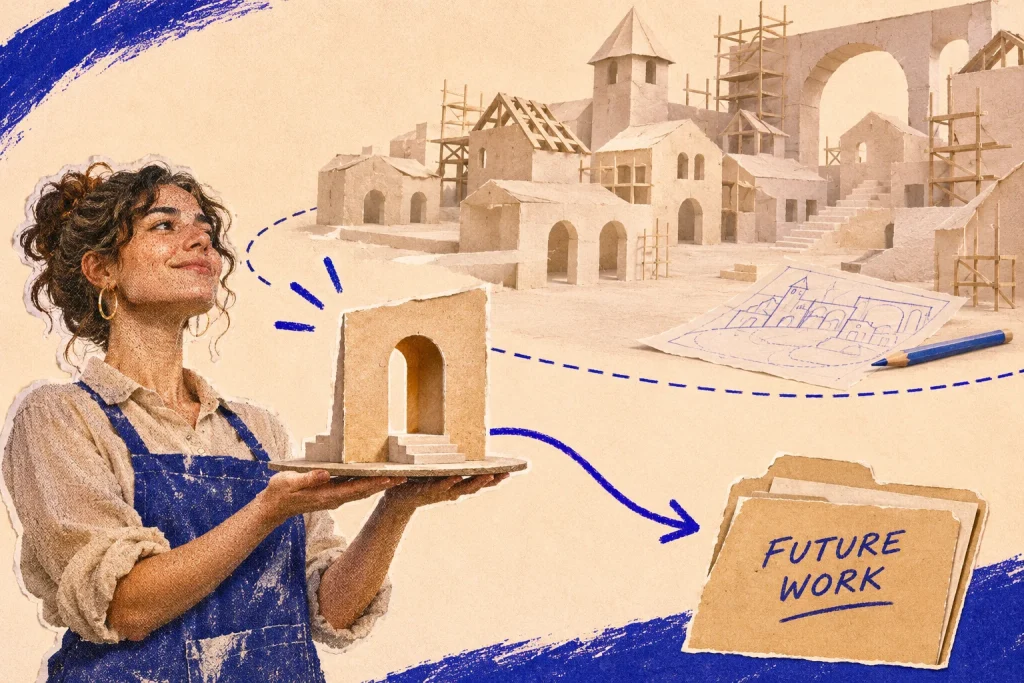
The prospect asks to see how the whole website might look before choosing a supplier. You begin with an opening screen, then add the services, a portfolio and a working enquiry route. The pitch is becoming a project before anyone has agreed what the project includes.
Choose the sales decision you are supporting
In this fictional example, a small studio is discussing a website for a commercial kitchen installer. The prospect wants confidence that the studio understands the difference between an initial assessment and a full installation proposal. The studio does not need to design every service page to have that conversation.
Write the immediate decision in a sentence: should both parties proceed to a defined planning stage? This gives you a basis for selecting the meeting material. It is different from deciding the site architecture, approving final copy or accepting a production build. Those may require work that belongs in a separately agreed stage.
Option one: a prepared discussion
The lightest option is a conversation using the prospect’s confirmed situation, relevant existing work you may show and a short outline of the proposed next stage. Explain the problem you understand and the questions still unanswered. No bespoke interactive prototype is promised.
This may be enough when the prospect needs to judge fit, working approach and what information would be required next. It is not enough to pretend that an unexamined requirement has been solved. If a question needs investigation, put that investigation in the proposed planning stage rather than answering it with an attractive guess.
Option two: one limited demonstration
A more visual conversation might show one illustrative route from the assessment description to an enquiry explanation. State the scope: one route, sample content and a discussion of its reasoning. Record which parts are static, simulated or genuinely functional in the demonstration you actually prepare.
Choose a preparation boundary you can manage and explain it before accepting additions. A new audience journey, real service copy or a functioning customer intake process may change the work substantially. Describe those as possible next-stage deliverables rather than allowing each request to enlarge the pitch invisibly. This is a service-design choice, not a universal rule about how much work every studio should provide without charge.
Option three: separately agreed discovery
If the prospect needs a content map, stakeholder interviews or alternative journeys before choosing a design direction, propose a defined discovery stage. Describe its inputs, activities and outputs. For the kitchen installer, an output might be an agreed service-page outline and a list of unresolved intake requirements, rather than a finished website.
Set out how that stage will be reviewed and what happens afterwards. Any price, timing, use of outputs and commercial terms need to be agreed for the actual engagement. This article does not supply contractual wording or an industry-standard fee. Its purpose is to make the work visible enough that you can discuss those arrangements properly.
Use a small stage card in the meeting
A useful card has five headings: decision we are supporting; material we will bring; material we are not preparing at this stage; what the prospect should contribute; proposed next decision. Keep the language specific. “A quick demo” is weaker than “one illustrative assessment-enquiry route using clearly marked sample text”.
For the example, the prospect supplies confirmed service distinctions. The studio supplies the bounded demonstration. The conversation ends by deciding whether to commission discovery and which questions it should settle. If the prospect needs something different, you can discuss it as a change to the stage rather than discover the mismatch after building it.
Review the effort after the conversation
Note which material helped the prospect judge the next step and which preparation was unnecessary. Keep reusable, properly cleared demonstration structures separate from client-specific material. You can improve your future pitch process without claiming that a particular prototype will win work. The useful boundary is a stage both parties understand, with a credible route to the work that follows.
Limit the prototype to the decision being discussed and record what the next stage includes. A reusable demo-content setup can support that bounded approach without turning a pitch into an entire build.
For the demonstration itself, choose one question a website prototype should help answer. To present the route clearly, start with a five-minute walkthrough built around one customer task.

Discussion 0
What did this article make you think about?